

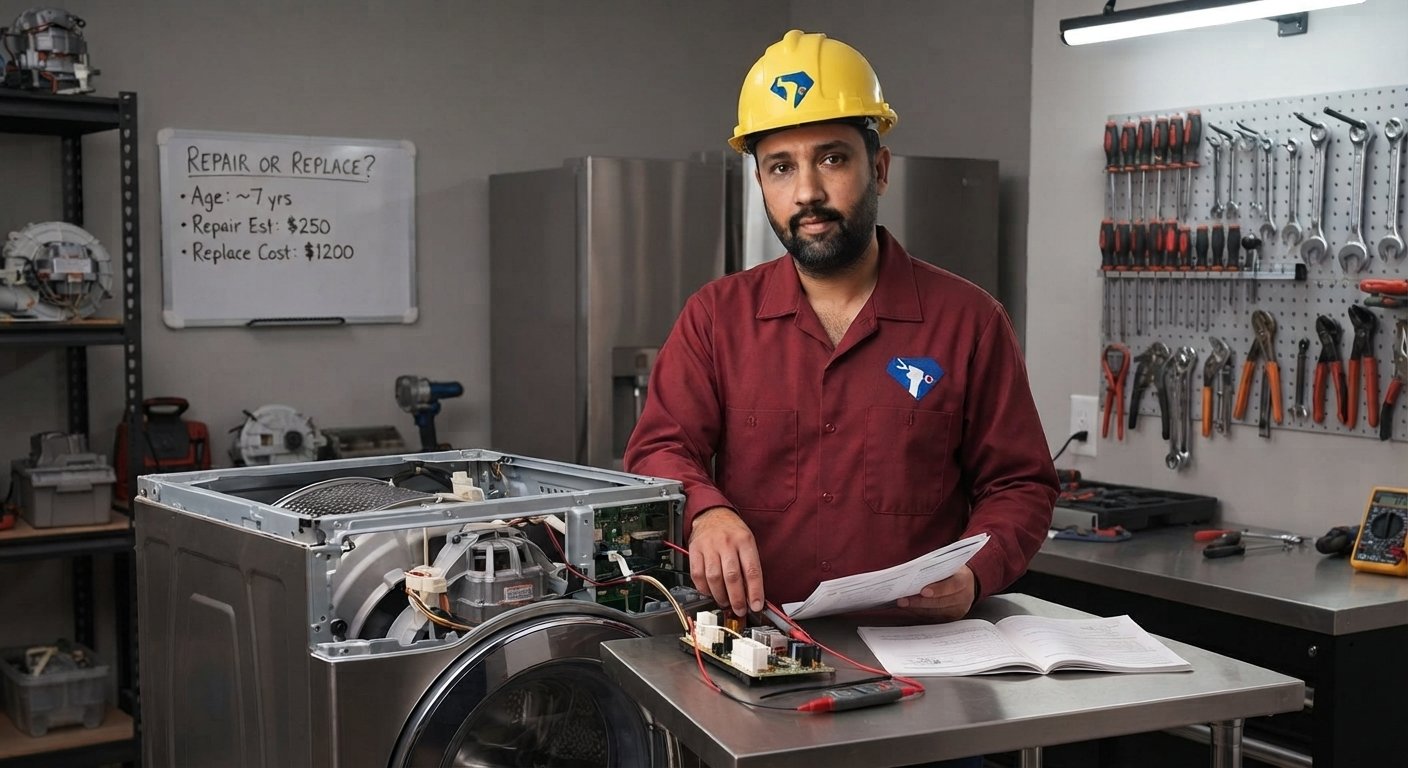
When a home appliance suddenly stops working, one of the first questions homeowners ask is: “Should I repair it or replace it?”
The answer isn’t always obvious. A refrigerator, washing machine, dryer, dishwasher, oven, or cooktop can often be repaired quickly and affordably. In other situations, continuing to fix an older appliance may cost more than investing in a modern, energy-efficient model.
Knowing what factors to consider helps you make a smart decision and avoid spending money unnecessarily.
Table of Contents
1. Consider the Age of the Appliance
The age of your appliance is one of the most critical factors in this decision. Most major household appliances have an expected service life, though actual longevity depends on brand quality, usage, maintenance, and past repairs.
- Newer appliances: If your appliance is relatively new and experiencing its first major issue, a repair is almost always worth considering. A quality unit will likely give you many more years of reliable service.
- Older appliances: If the unit is past its prime and has started experiencing repeated failures, replacement is usually the more financially sound choice.
2. Compare the Repair Cost With Replacement Cost
Before making up your mind, find out what is actually wrong. A professional technician can diagnose the problem and determine whether a repair is practical. Once you know the required fix, compare that cost with purchasing a brand-new replacement.
For example, a relatively inexpensive repair on a newer dryer is a much better choice than buying a new machine. Conversely, a major component failure on an aging appliance may not be worth the investment.
Pro Tip: Never guess based solely on the symptom. A machine that won’t start could have several root causes, and the actual repair cost depends heavily on the specific failed component and model.
3. Think About How Often It Breaks Down
One repair doesn’t mean an appliance is at the end of its lifecycle. However, repeated breakdowns are a major warning sign.
If you have already paid for multiple service calls and another issue pops up, add up your recent repair expenses. Constant maintenance can quickly become a money pit and a source of daily frustration. If an appliance is chronically breaking down, replacing it provides better long-term reliability and peace of mind.
4. Check Parts Availability
Some older or discontinued appliances are difficult to service simply because replacement parts are no longer manufactured or readily available. Even if a technician pinpoints the problem, a repair won’t be practical if the necessary component is backordered or discontinued. Always ask your technician if the required part is easy to source.
5. Factor in Energy Efficiency
Older appliances often consume significantly more electricity or water than modern models. This is especially true for heavy-use appliances like refrigerators, washers, and dryers.
If an older appliance is already requiring expensive fixes, upgrading to an energy-efficient model can lower your utility bills over time. However, energy savings alone don’t always justify an immediate replacement—you should weigh efficiency alongside age, condition, and overall repair costs.
6. Evaluate the Appliance’s Overall Condition
Look past the immediate breakdown and ask yourself a few key questions:
- Has the appliance been reliable up until now?
- Are there signs of rust, corrosion, or water leaks?
- Are other internal components starting to wear out or fail?
- Is the model discontinued?
If the appliance is generally well-maintained and the issue is isolated, repairing it makes sense. If multiple systems are failing at once, it’s likely time for an upgrade.
7. Take Safety Problems Seriously
Some appliance issues should never be ignored. Gas leaks, electrical burning smells, sparking, severe overheating, or damaged wiring require immediate attention. If your appliance shows signs of dangerous electrical or gas behavior, stop using it immediately and call a professional. Safety should always come before repair costs.
8. Don’t Automatically Replace a Non-Working Appliance
A common mistake is assuming that a completely dead appliance is unfixable. Many breakdowns are caused by a single worn-out component:
- A washer that won’t drain might just need a new drain pump.
- A dryer that won’t heat could simply have a blown thermal fuse.
- A refrigerator that isn’t cooling may have a faulty defrost timer or condenser fan.
A proper professional diagnosis tells you whether you are facing a simple fix or a failing machine.
Quick Reference: The Repair or Replace Appliance Guide
Repair usually makes sense when:
- The appliance is relatively new.
- The problem is isolated to a single part.
- The repair cost is reasonable.
- Replacement parts are readily available.
- The unit has otherwise been reliable.
Replacement usually makes sense when:
- The appliance is very old.
- It has frequent, repeated breakdowns.
- Multiple major components are failing.
- Parts are discontinued or hard to find.
- The repair cost is close to the price of a new unit.
- There are structural, rust, or safety concerns.
Get a Professional Diagnosis in the Dallas–Fort Worth Area
The best way to decide whether to repair or replace an appliance is to understand the exact root cause first.
At Ahmad Home Solutions LLC, our expert technicians diagnose problems with major household appliances, helping homeowners across the Dallas–Fort Worth Metroplex make informed, budget-friendly choices. Our goal isn’t just to sell you a service—we want you to understand all your options so you can choose what’s best for your home.
If your refrigerator, washer, dryer, dishwasher, oven, or cooktop isn’t working properly, don’t immediately assume you need a replacement.
Call us today: +1 (817) 522-3699
